Florida is one of the most regulated states in the country for mold work, and for good reason, the climate makes mold a near-permanent risk for buildings, and the industry has historically had a conflict-of-interest problem. Here's how that separation works in practice.
How many mold licenses does Florida have?
Florida statute (Chapter 468, Part XVI) creates two separate licenses:
- Mold Assessor (MRSA): the inspector. Licensed to evaluate, sample, and write reports.
- Mold Remediator (MRSR): the contractor. Licensed to remove, clean, and rebuild.
The two licenses cannot be held by the same individual or company performing work on the same property. This is the assessor/remediator separation, and it is the single most important consumer protection in Florida mold law.
Why does the separation matter?
If the same company that finds the mold also gets paid to remove it, it has a financial incentive to find more mold than is actually there. That conflict is the reason the assessor and remediator roles are held separately. PureSpec does not provide remediation or earn remediation revenue from correcting the conditions it reports.
That doesn't mean every "we do both" company is unethical, some carefully separate the work via partner companies. But the structural risk is real, and a clean assessor-only operation removes the conflict entirely. PureSpec is assessment-only.
What “IEP” means, the modern industry term
The mold-and-IAQ industry increasingly uses the term Indoor Environmental Professional (IEP) in place of “mold inspector.” The term comes from the IICRC S520 Standard and Reference Guide for Professional Mold Remediation, which defines the IEP as the independent third-party expert who assesses microbial conditions, develops sampling protocols, and writes the remediation scope of work. An IEP is, by definition, independent from any remediation contractor.
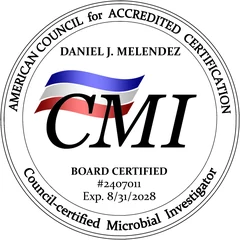
An IEP is not a substitute for the Florida state license, in Florida the legal title is still “Mold Assessor” (MRSA), but it is the language insurance carriers, attorneys, healthcare providers, and remediation standards documents increasingly use for the role. Daniel Melendez is both: a Florida State Licensed Mold Inspector & Assessor (MRSA #4575) and an Indoor Environmental Professional (IEP).
What does Florida mold licensing require?
To hold an MRSA (Mold Assessor) license in Florida:
- Documented experience in microbial assessment
- Accredited training course
- State exam
- General liability and professional liability insurance
- License renewal with continuing education every two years
Verify any assessor at myfloridalicense.com. Type the company or individual name and confirm the MRSA license is active and not under disciplinary action.
What can a licensed assessor not do?
- Subcontract remediation on the same property they assessed
- Refer in exchange for kickbacks, commissions, or split fees
- Misrepresent test results to drive remediation work
- Issue reports without their license number on the document
What testing standards apply in Florida?
Florida does not set numeric "safe" thresholds for indoor mold spore concentrations, but accredited labs (AIHA, NVLAP, A2LA) follow standard analytical methods. PureSpec works with accredited labs and reports raw counts plus the lab's reference frame, not opinions dressed up as thresholds.
How does this affect a real estate transaction?
A pre-purchase mold inspection from a licensed assessor protects the buyer; a clean post-remediation verification protects the seller.
Bottom line
Hire an assessor whose license is active, who is licensed-only as an assessor (not also as a remediator), and whose report can be released without redaction. That's the floor for a credible inspection.