
Independent Clearance
Mold clearance testing after remediation
Post-remediation verification (PRV), performed independently.
Has the mold removal work been completed? PureSpec performs an independent mold clearance inspection, also called post-remediation verification or PRV, to check the documented work area against the project criteria. Daniel reviews the visible conditions, moisture readings and laboratory results, then reports what meets the criteria and what remains unresolved. PureSpec never performs remediation.
What is a mold clearance test?
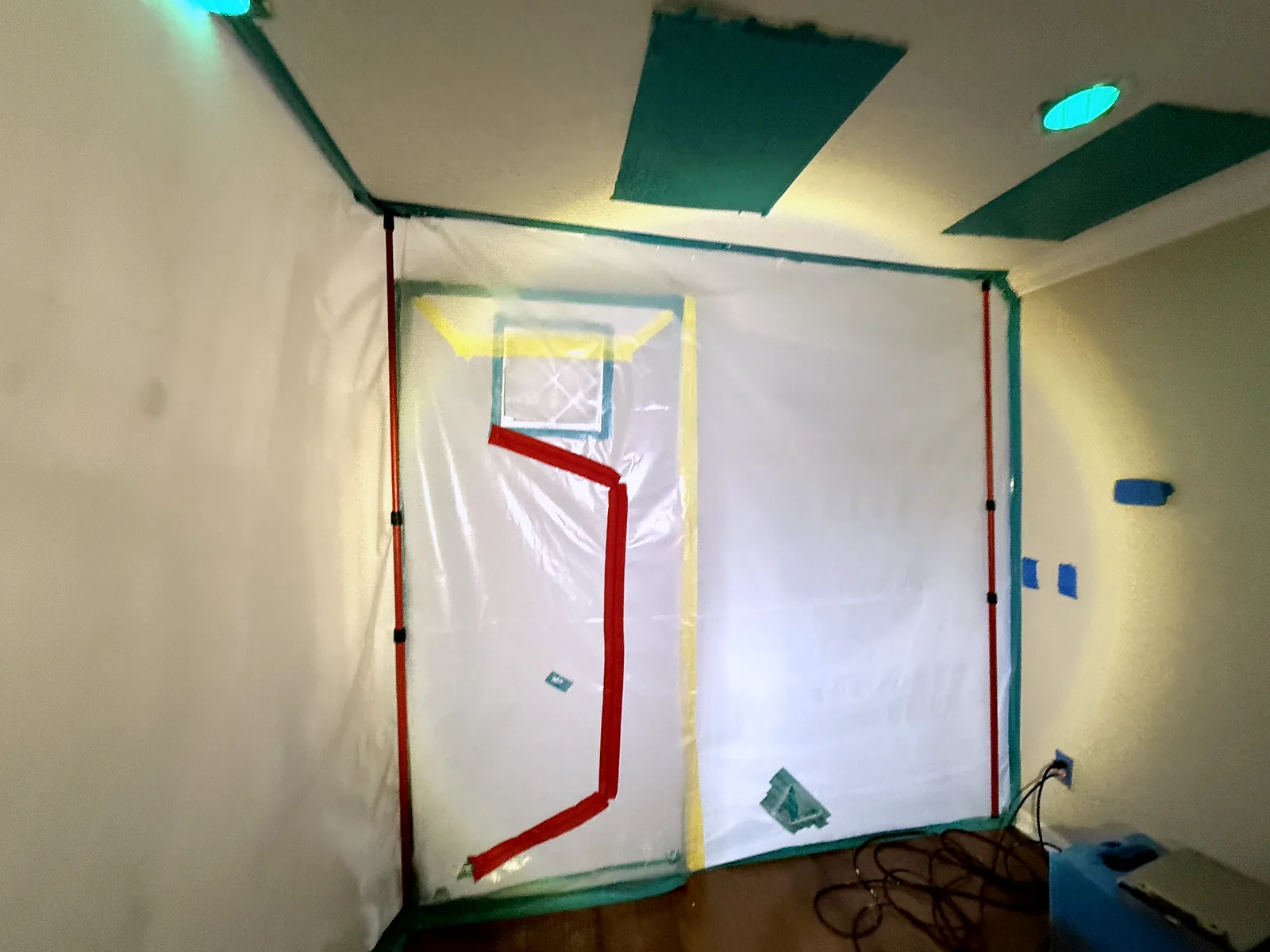
A mold clearance test, also called post-remediation verification or PRV, checks the documented work area after a mold remediation contractor finishes. It involves more than taking an air sample. PureSpec examines the contained area, measures moisture in affected materials, and collects surface and air samples interpreted with an outdoor reference taken the same day. The written report explains which project criteria were met and what remains unresolved. The inspection is limited to the agreed remediation area; it does not evaluate every room in the building. Scheduling is coordinated around completion of the remediation work and the containment conditions needed for the assessment. PureSpec performs assessment and testing only and never performs remediation, so the company checking the work is independent of the company that performed it. If a criterion is not met, the report identifies the outstanding finding and why it matters to that evaluation.
What it covers
What does mold clearance testing include?
- Visual clearance inspectionThe previously remediated area is examined for any remaining visible mold, debris, or dust the remediation missed.
- Moisture and thermal verificationMoisture-meter readings at the affected assemblies, interpreted for the material and compared with the project’s drying criteria. Thermal imaging helps direct where readings are taken.
- Air sampling with outdoor referenceAir samples inside the contained area, interpreted against an outdoor reference and alongside the visual and moisture findings.
- Surface samplingPreviously affected substrates are sampled where the project criteria call for it, to document surface conditions.
- Independent lab analysisSamples ship under chain of custody to an AIHA-LAP accredited third-party laboratory, read against the outdoor baseline.
- Written verification reportWhich criteria were met, which were not, and the reasoning, with the limitations of the evaluation stated plainly.
When you need it
When is this service the right fit?
- Remediation contractor says the work is done, verify before paying
- Insurance carrier requires third-party clearance
- HOA or condo association requires clearance before occupancy
- Real estate transaction conditional on clearance
- Tenant return after remediation
What it consists of
Three parts, in this order.
- Visual inspection (while containment is still up). Dust deposits on surfaces inside the containment, residual staining on substrates, surface cleanliness of framing and structural elements, structural integrity of the rebuild prep. Photographed throughout. The visual portion is only meaningful while containment is intact and the area has not been reopened to the rest of the building.
- Air clearance sampling. Active spore-trap air sampling inside the contained area plus an outdoor reference sample collected at the same visit, under the same conditions. The outdoor sample is a reference; the indoor result is interpreted against it and against the criteria set for the project. Samples are sealed under chain-of-custody and shipped to an accredited third-party laboratory.
- Written interpretation. The lab results are interpreted against the outdoor reference and against the pre-remediation findings (when those are available). The report states which criteria were met, which were not, and the specific reason for any unmet criterion.
When to schedule
Timing is non-negotiable.
The PRV must happen after the remediation contractor has finished cleaning and HEPA-vacuuming the contained area but before:
- Containment barriers are removed
- The negative-air machine is shut down
- Any reconstruction begins (drywall replacement, flooring, paint, baseboard install)
- The previously contaminated area is reopened to the rest of the building
If containment is broken before clearance, the air sample no longer represents the post-remediation condition of the work area, it represents the post-remediation condition plus whatever happened during the breach. Most remediation contractors know to schedule PRV before takedown; if yours has not, call us before they break containment.
If it fails
A failed PRV is not the end of the project.
A failed PRV is a finding, not a verdict. The report names exactly which deficiency drove the failure: residual visible mold, elevated indoor spore counts versus the outdoor baseline, unaddressed moisture source, incomplete containment integrity, or a laboratory result that needs explanation. The remediation contractor addresses the stated deficiency, and PureSpec can return to evaluate the area again.
Unmet criteria found before the containment comes down are far easier to act on than a problem discovered after reconstruction, or after the building changes hands. That is the point of an independent evaluation step.
Why Florida specifically
Florida conditions that affect verification.
Several Florida conditions affect when and how verification is scheduled:
- Repeated named-storm water events. Hurricane Ian (2022), Idalia (2023), Helene (2024), and Milton (2024) drove statewide rebuild cycles. Where a property has been through more than one remediation project, a separate verification record for each one keeps the history clear.
- Year-round humidity load. A contained area in a Florida building can reabsorb moisture from the surrounding structure within hours if dehumidification fails. Clearance must happen before that re-equilibration, not after.
- Slab-on-grade construction. Moisture at the slab can affect adjacent materials, so verification includes moisture readings at those assemblies before drywall closes in.
Why it matters
Why a PRV matters.
- Documents the work area against defined criteria, rather than relying on whether it "looks finished."
- Provides peace of mind to homeowners, tenants, and prospective buyers, with documentation that's not from the company that did the work.
- Independent by design. PureSpec never inspects and remediates the same property, so we are structurally separate from the contractor who did the work.
This inspection is limited strictly to the remediated areas. Non-affected or unremediated portions of the home are not included in the PRV scope.
Service areas
Where we perform Post-Remediation Verification (PRV).
Orlando and Central Florida as the primary market, with statewide Florida projects available based on scope, scheduling, and travel requirements. Click the county nearest you for local context.
- Orange County, FL
- Lake County, FL
- Osceola County, FL
- Seminole County, FL
- Polk County, FL
- Hillsborough County, FL
- Pinellas County, FL
- Miami-Dade County, FL
- Broward County, FL
- Palm Beach County, FL
- Volusia County, FL
- Brevard County, FL
- Duval County, FL
- Marion County, FL
- Alachua County, FL
Dedicated county PRV pages with local clearance context: Orange, Miami-Dade, Broward, Palm Beach, Hillsborough, Pinellas, Duval, and Lee counties.
Honest answers
Questions about mold clearance testing.
When should a PRV be performed?
After the remediation contractor finishes and before the containment comes down, the invoice is paid, or the area is reopened to the rest of the building. Once containment is removed, the conditions it was holding are gone.
Can the remediation contractor issue its own clearance?
A document written by the party that was paid to do the removal carries a conflict that no amount of individual integrity removes from the page. PureSpec never verifies its own remediation work, because we never remediate at all.
What happens if a project criterion is not met?
The report states exactly what remains outstanding and why, so the contractor has a specific list to work from rather than a general objection.
Central Florida coverage