
Full Inspection
Full-property mold inspection, every accessible space, scientifically.
An entire-property mold inspection is the most thorough assessment PureSpec offers. Daniel personally walks every accessible space in the building, interior rooms, attic, accessible HVAC, water-using rooms, and any visible exterior moisture concerns, using moisture mapping, thermal imaging, and on-site instrumentation. Lab-supported sampling is added when conditions warrant.
3 Laboratory Samples Included Add-on samples available
Standard coverage includes Orange, Seminole, Lake, Osceola and Polk counties. For properties outside these counties, contact PureSpec for a written quote before booking. Any travel charge is disclosed in your written quote.
What is an entire-property mold inspection?
An entire-property mold inspection examines every accessible space in the building rather than one reported room. It combines a room by room visual inspection, moisture readings on suspect surfaces, thermal imaging, real-time airborne particle counting from roughly 0.3 to 10 microns, and on-site screening for carbon dioxide, total volatile organic compounds and formaldehyde. The accessible parts of the air conditioning system and the attic or substructure are included where they can be entered safely. Three accredited-laboratory samples are included and placed where the findings point, not sold as the inspection itself. The purpose is to locate the moisture allowing growth, not only to confirm that spores are present. PureSpec performs environmental assessment and testing only and never performs remediation, so the report has no work to sell on the back of its findings.

What it covers
What a full-property inspection covers.
Organized by building system rather than by deliverable, because moisture moves through a building along systems and that is how the inspection is actually run.
Rooms and finishes
Every accessible interior space, examined for visible growth, water staining and the conditions that allow growth.
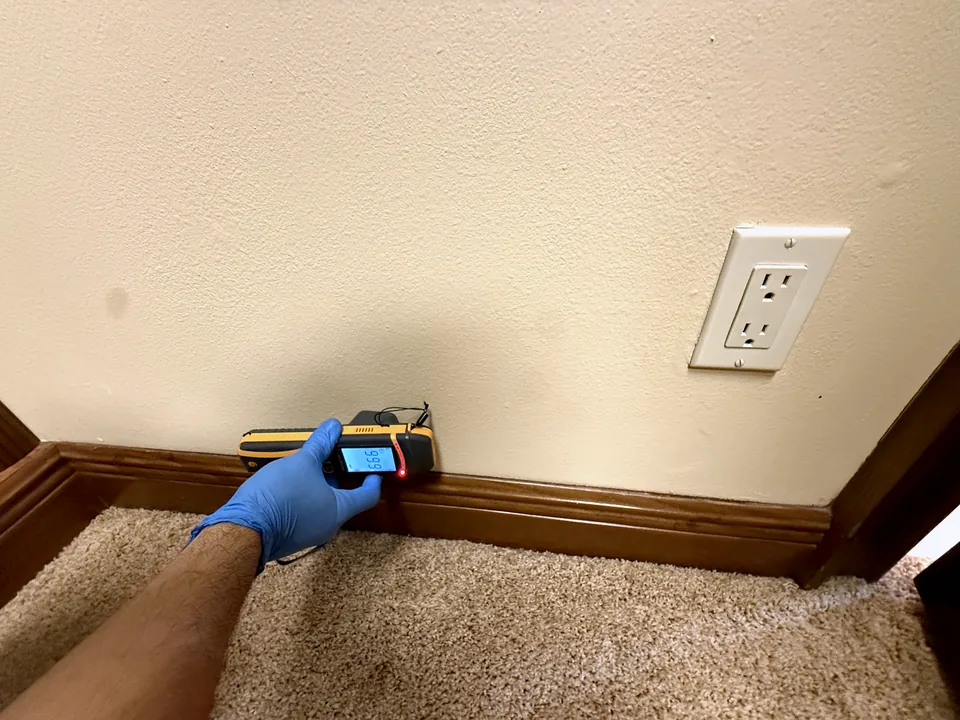
- Moisture readings on drywall, ceilings, floors, baseboards, cabinet and under-sink bases, showers, tubs, kitchen and laundry
- Radio-frequency meter: reads a short depth into the material without marking it
- Pin-and-scan meter: confirms a reading inside the material
- Extended-reach probe: spots a hand-held meter cannot get to
A stain records that something was wet once. A meter says whether it still is.
The building envelope
Thermal imaging reads the surface-temperature differences that can point to moisture behind walls and ceilings.
- Around windows
- At plumbing penetrations
- Along the roofline
It reads temperature, not moisture, so a cold patch is a place to investigate rather than a finding on its own.
The air conditioning system
Each air handler is opened and checked, along with the ducts it feeds.
- Blower compartment, coil, drain pan and line
- Supply plenum, inside with the borescope where an existing access opening allows
- Return plenum and its insulation
- Filter, and unsealed openings that let unfiltered air bypass it
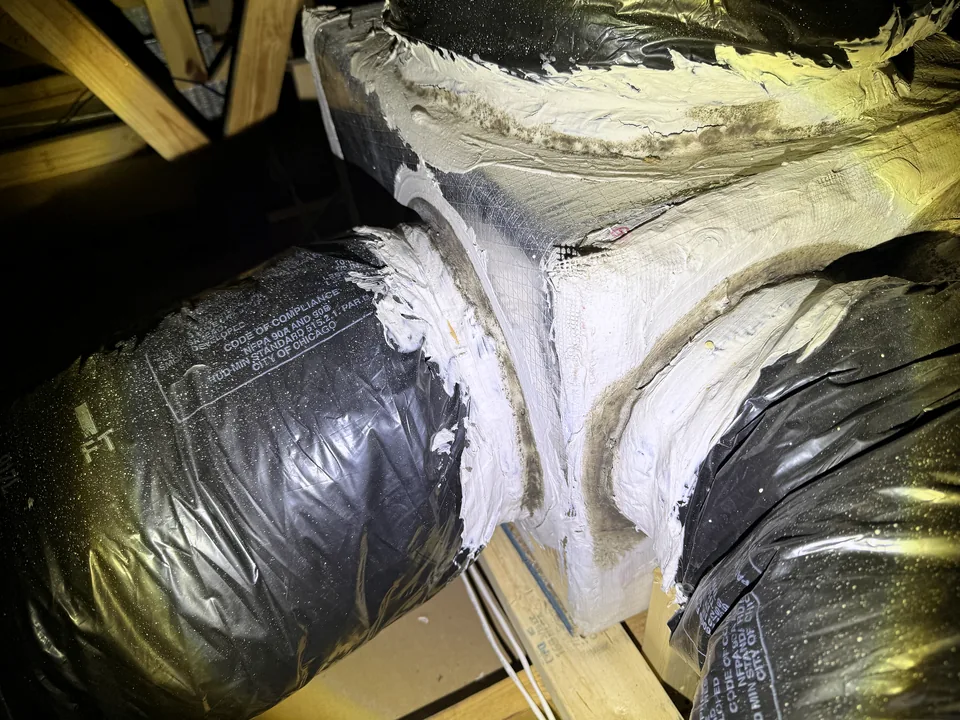
- Attic duct connections, vent boots and duct insulation, for condensation and growth
- Supply registers, for condensation on the room side
In much of the Florida housing stock the air handler sits in the attic or a closet, which puts the coil, drain pan and duct connections outside any room an air sample would be taken in.
Attic and substructure
Checked where the space exists and can be entered safely.
- Roof sheathing, framing and evidence of past leaks
- Insulation, including insulation wetted by condensation from ductwork above
- Ventilation: insulation packed against the soffit vents cuts off the intake air an attic needs to shed heat and humidity
- Thermal patterns consistent with gaps in ceiling insulation
- Raised-floor houses get the same checks underneath
Where a space cannot be entered safely, the report says so rather than implying it was covered.
Humidity and dew point, room by room
A hygrometer records conditions in each area, with an outdoor reading for reference.
- Temperature
- Relative humidity
- Dew point
Condensation forms on any surface colder than the dew point of the air around it, so these readings show whether the building itself is producing moisture, even where no leak is visible. They describe conditions during the visit, not a permanent state.
Air movement and air leakage
Tracer smoke testing makes air movement visible.
- Air handler cabinet and plenums
- Duct joints and boots
- Building envelope: penetrations and openings where outdoor or attic air can enter
Humid outdoor air reaching a cooled surface, or cooled air leaking into a hot attic, is where condensation becomes possible. The smoke shows direction and path, not volume, so it is a qualitative building-science check rather than a duct-leakage or blower-door measurement.
Air, measured on site
A calibrated laser particle counter measures airborne particle concentrations in real time, room by room.
- Multiple size channels, roughly 0.3 to 10 microns
- Measured against a cleaner reference space instead of guessed at
- Shows which rooms drive the particulate load
Carbon dioxide, VOCs and formaldehyde
A professional indoor air quality meter takes live readings during the visit, recorded room by room so they can be compared across the property.
- Carbon dioxide
- VOCs
- Formaldehyde
This is screening, not the accredited-laboratory analysis. When the readings raise a question, the VOC or formaldehyde lab test can be collected the same day.
How it runs
How the inspection is actually performed.
-
Before the visit
History
What the building is, how it has been occupied, and what is known about past leaks, repairs, remediation or storm damage. Age and construction type matter: a 1950s raised-floor house and a 2020s slab house with the air handler in the attic fail in different places. This decides where the visit starts rather than starting at the front door and working clockwise.
-
On site, first
Building, then air
Moisture readings, thermal imaging and the accessible mechanical, attic and substructure spaces all come before any sample is taken. Air data gathered without first understanding the building is a number with no cause attached to it, and a spore count on its own cannot say where the water is coming from or whether it is still arriving. Why a normal air test does not rule out hidden mold
-
Decided on site
Sampling that answers something
Three accredited-laboratory samples are included with a complete inspection, air, surface or wall cavity, placed where the findings point rather than allocated in advance. Every sample ships under chain of custody, and an air sample is paired with a same-day outdoor reference, because an indoor count means nothing without one. Mold testing
-
Afterward
Report, and what to do next
Photographs, instrument readings and laboratory results in plain English, stating what was reached and, just as clearly, what was not. Laboratory results follow 24 to 72 hours after the lab receives the samples. Where remediation is warranted, a written protocol can be developed separately and handed to a contractor of your choosing.
Daniel performs every assessment himself. There are no subcontracted inspectors and no technician sent in his place. About Daniel
Optional lab testing
Testing you can add.
Three laboratory samples, air, surface, or wall-cavity, are included in the base fee, collected where the findings call for them. When you need more than spore and moisture data, any of these specialty panels can be added, and the cost is quoted up front before we arrive:
- ERMI & HERTSMI-2 dust panelsDNA-based mold analysis scored against water-damaged-building markers, frequently requested for CIRS and MCAS medical documentation.
- Mycotoxin testingDetects the toxins some molds produce, a different question than how many spores are present.
- Pathways™ testingMicrofiber-swab sampling analyzed for peptide-bond protein, collected to manufacturer protocol.
- VOC & formaldehyde testingChemical off-gassing measurements for indoor-air-quality concerns beyond mold.
- Endotoxin testingBacterial-marker analysis for water-damaged or agricultural environments.
- Legionella water testingSampling of building water systems, cooling towers, potable water, spas, and fountains, for the bacteria that causes Legionnaires’ disease.
Add-on panels: ERMI, HERTSMI-2, mycotoxin, Pathways™, VOC, formaldehyde, endotoxin, and Legionella water testing. Every sample ships under chain of custody to an accredited third-party laboratory.
Screening vs. lab
On-site screening or accredited lab testing?
The included indoor air quality screening reads carbon dioxide, VOCs, and formaldehyde in real time, on site. The accredited-laboratory test quantifies specific compounds for documentation. Here is how they compare:
| On-site IAQ screening (included) | Accredited lab testing (add-on) | |
|---|---|---|
| Measures | Carbon dioxide, total VOCs, and formaldehyde, in real time | Specific compounds quantified by an accredited lab |
| Purpose | Compare real-time readings across rooms, on the spot | Documented, traceable numbers the client can share as needed |
| Turnaround | Immediate, during the visit | 24 to 72 hours after the lab receives the sample |
| Best for | A fast read, and deciding whether lab testing is worth it | Formal documentation and precise identification |
When you need it
When is this service the right fit?
- Buying or selling a Florida property
- Insurance claim documentation
- After a major water event (hurricane, plumbing failure, roof leak)
- Health-driven concerns and unexplained indoor air quality issues
- Tenant disputes requiring full-property documentation
- Healthcare provider-referred environmental assessment for CIRS/MCAS
Choosing
Full property, limited scope, or HVAC only?
The difference is what gets examined, not how carefully. Each of the three is performed the same way inside its own boundary.
| Full property | Limited scope | HVAC only | |
|---|---|---|---|
| Area examined | Every accessible space in the building | One named room or area and what adjoins it | The air conditioning system and its accessible components |
| Laboratory samples included | Three | Scoped to the area in question | One |
| Answers | Is there a moisture problem anywhere in this building, and where | What is happening in this specific place | Is the system itself the source |
| Usual reason | A purchase, a claim, a health question, or an unexplained odor with no obvious source | A known leak or a visible patch in one room | Musty air at the registers, or growth returning after cleaning |
| Read more | This page | Limited scope | HVAC inspection |
If the reported problem turns out to reach past the area booked, the report says so. Scoping down to save a visit is a false economy when the source is somewhere the narrower inspection was never going to look.
Honest limits
What a full inspection does not settle.
It does not open the building
An assessment is non-destructive. Where evidence points inside an assembly, a borescope can look through a small access point, but nothing is demolished to find out. Growth fully enclosed with no moisture signature, no odor and no thermal difference can be missed, and the report says where that risk sits. Looking inside a wall cavity
It is not a medical opinion
The assessment produces environmental data. What that data means for a person's health is a question for a licensed clinician, and a HERTSMI-2 result is a score rather than a conclusion about a building's fitness to live in.
It is not remediation, and never becomes it
PureSpec assesses only. No remediation is sold, performed or subcontracted on a building PureSpec has inspected, which is why the findings have no work attached to them. Where cleanup is warranted, the protocol is written to be handed to a contractor of your choosing.
It is a record, not a verdict
The report is an independent factual record of what was measured and observed on the day, with photographs and laboratory results. Questions about obligations between parties belong with a Florida attorney rather than with an inspector.
What each instrument can show, and what it cannot.
Every instrument on an inspection answers a narrow question. Reading more into one than it can support is how a confident wrong conclusion gets made.
| Tool | What it helps identify | What it does not prove |
|---|---|---|
| Moisture meters (three types) | Comparative moisture patterns in compatible materials | Does not identify mold, and does not automatically identify the moisture source. |
| Thermal camera | Surface-temperature patterns that can direct further investigation | Does not see through walls, and does not measure moisture directly. |
| Borescope | Visual conditions inside an accessible cavity through a small opening | Shows only the field of view reached. It cannot characterize the entire concealed assembly. |
| Hygrometer | Temperature, relative humidity and dew point, so condensation risk can be judged | Describes the visit, not long-term conditions, and says nothing on its own about whether mold is present. |
| Tracer smoke | Direction and path of air movement at leaks, joints and openings | Shows no quantity. It is not a duct-leakage or blower-door measurement. |
| Particle counter | Real-time airborne particle concentration by size channel | Cannot distinguish mold from dust, fibers, skin, combustion particles, or other aerosols. |
FAQ
Entire-property mold inspection, common questions.
How much does an entire-property mold inspection cost in Florida?
The price depends on the size of the property and how much laboratory sampling the findings call for. An entire-property inspection with PureSpec includes three accredited-laboratory samples in the base fee, with additional air, surface, or wall-cavity samples available when conditions warrant. Call (321) 324-7756 for a written quote before anything is scheduled; there are no surprise charges at the door.
How long does a full mold inspection take?
Most single-family entire-property inspections take roughly two to three hours on site, depending on square footage, attic and crawl-space access, and how many areas need moisture mapping or thermal imaging. Larger or multi-story homes take longer. Laboratory results follow separately, and your written report is delivered within 24 hours of the lab returning data.
What is the difference between a mold inspection and mold testing?
A mold inspection is the full investigation: a visual assessment, moisture mapping, thermal imaging, and HVAC and attic evaluation that finds where moisture and growth are and why. Mold testing is just the laboratory sampling step. An entire-property inspection includes both. If you only need lab numbers, see mold testing, or read mold inspection vs. mold testing.
Do I need a whole-property inspection or just one room?
If you already know exactly where the concern is, one bathroom, one ceiling stain, a single water-loss area, a limited-scope mold inspection may be all you need. Choose the entire-property inspection when the problem is unexplained, you are buying or selling, an insurer or attorney needs full documentation, or health symptoms have no obvious source.
Does the inspection include laboratory testing?
Yes. Three accredited-laboratory samples are included in the base fee, collected where visual and moisture findings indicate they are useful. Samples ship under chain of custody to an AIHA-LAP accredited third-party laboratory. PureSpec performs assessment and testing only and does not provide remediation. Clients hire a separate contractor when corrective work is needed.
How soon will I get the inspection report?
Your written report is delivered within 24 hours of the laboratory returning results. It documents every finding in plain English with photographs, instrumentation data, moisture readings, lab analysis, and clear next steps, organized so the client and relevant third parties can follow the basis for the findings.
Does a complete mold inspection include air quality testing?
Yes, in two separate senses. Every complete inspection includes on-site instrumentation: real-time airborne particle counting across roughly 0.3 to 10 microns, and a live screening of carbon dioxide, total VOCs and formaldehyde. Separately, any of the included laboratory samples can be an air sample, which is the mold spore air test most people mean. Specialty lab panels remain available as add-ons.
What does the particle counter measure?
A laser particle counter measures the concentration of airborne particles across several size channels, roughly 0.3 to 10 microns, in real time. It puts a number on the particulate load in each room and helps pinpoint the areas driving elevated readings, which a visual inspection alone cannot show.
Is the CO2, VOC, and formaldehyde screening the same as the lab test?
No. The on-site screening is a real-time reading from a professional indoor air quality meter, recorded room by room and compared across the property rather than labeled normal or elevated. The accredited-laboratory VOC and formaldehyde test quantifies specific compounds for documentation. The screening is included; the lab test is an add-on, and it can be collected the same day if the screening flags a concern.
Service areas
Where we perform Entire Property Mold Inspection.
Orlando and Central Florida as the primary market, with statewide Florida projects available based on scope, scheduling, and travel requirements. Click the county nearest you for local context, or go straight to a city page such as Clermont or Winter Garden.
Central Florida coverage