
Home · Credentials
Credentials & certifications.
Florida State License
Mold Assessor · MRSA #4575
Florida Department of Business & Professional Regulation
Florida requires a state-issued Mold Assessor license (MRSA designation) to legally perform mold inspection or assessment for compensation. The license has prerequisites: documented experience, accredited training, a state exam, and liability insurance. It must be renewed every two years and is publicly verifiable.
Business accreditation
BBB Accredited Business
Better Business Bureau
The Better Business Bureau accredits businesses that apply and are approved against its standards for trust, which cover honest advertising, transparency about who owns and runs the business, and responsiveness to customer complaints. Accreditation is reviewed by BBB rather than self-declared, and it can be revoked.
It says nothing about mold science, and it is not a substitute for the licensing and certification above. What it covers is how the business conducts itself with the people who hire it, which is the part a homeowner cannot check by reading a report.
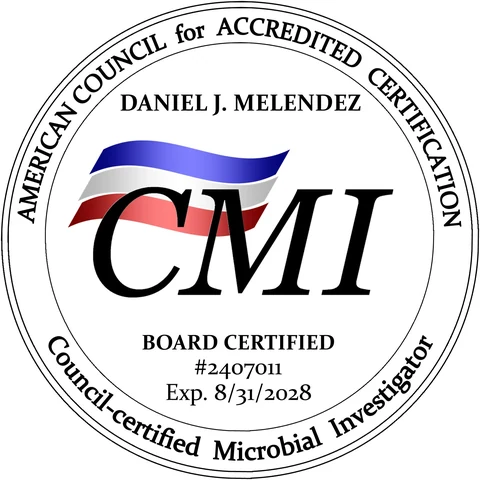
Independent third-party certification
Council-certified Microbial Investigator (CMI)
American Council for Accredited Certification
ACAC is an independent credentialing body. The CMI certification program it issues is accredited by the Council for Engineering and Scientific Specialty Boards (CESB), and ACAC states its CESB-accredited designations are the only ones in the indoor air quality field to hold that accreditation. The CMI is one of the most rigorous microbial-investigation credentials available in the United States. It is distinct from trade-association credentials: ACAC is not affiliated with the remediation industry, which is the entire point.
Holding the CMI means meeting an external standard, not an industry one. It is recognized by insurance carriers, attorneys, and healthcare providers across the country.
Industry certification
Certified Mold Hygienist
National Association of Environmental Restoration & Mold Contractors (NAERMC)
The Certified Mold Hygienist credential covers the science of mold contamination, growth conditions, sampling methodology, and indoor air quality assessment. It complements the state license and the ACAC certification by documenting specific training in the hygienic side of environmental work: understanding the hygienic factors in indoor environments and how to document them.
IAQ
Industry certification
Certified Green Indoor Air Quality Specialist
National Association of Environmental Restoration & Mold Contractors (NAERMC)
The Green Indoor Air Quality Specialist credential focuses on the indoor air quality side of environmental health: how building materials, mechanical systems, occupant practices, and ventilation interact to create either a healthy or an unhealthy indoor environment. It complements the mold-focused credentials by widening the lens from "is there mold growing?" to "is the air in this building actually safe to breathe over time?"
Academic degree
Bachelor of Science, Microbiology
Four-year university program
The academic basis. Four years of formal study in microorganism identification, growth conditions, laboratory analytical methods, and the scientific literature on indoor microbial environments. Most mold inspectors learn from a weekend course. The Microbiology degree is why Daniel reads lab reports the same way the labs that run them do.
Combined with the lab-analyst and trainer-of-analysts experience that followed, this is the credential under every other credential.
Specialty technician certification
Certified Pathways™ Technician
Pathways Testing (pathways-testing.com)
Pathways™ is a peptide-bond protein-detection methodology that uses microfiber swabs at building perimeter and transition points to map mold-contamination pathways at the protein level, not just the airborne-spore level. The certification covers the sampling protocol, chain-of-custody to the accredited Pathways laboratory, and interpretation of the resulting contamination-pathway map.
Daniel sought out this certification specifically to support complete environmental investigations for CIRS and MCAS cases, post-water-loss verifications, and pre-purchase due diligence where conventional spore-trap testing leaves questions unanswered. Learn more about Pathways™ Testing →
Book directly with Daniel.
Every credential above is held by one person, the same person who walks your property, takes the samples, and writes the report.
Standard coverage includes Orange, Seminole, Lake, Osceola and Polk counties. For properties outside these counties, contact PureSpec for a written quote before booking. Any travel charge is disclosed in your written quote.
How an inspection actually works
Twelve steps. Same scientific process, every property.
The depth of each step adapts to your situation. Tracer smoke testing and borescope inspection happen when conditions warrant. Sampling is decided based on what your specific environment is asking, not a fixed checklist.
- 01
Consultation
We talk through what you’re seeing, the building, and the question you need answered. Free, no pressure, no upsell.
- 02
Humidity and dew point
Temperature, relative humidity and dew point are recorded room by room, with an outdoor reference, because a surface colder than the dew point collects water without any leak.
- 03
Indoor air quality screening
Real-time particle counts across size channels, with on-site carbon dioxide, VOC and formaldehyde screening, room by room. Screening, not laboratory analysis.
- 04
Comprehensive HVAC evaluation
Each air handler is opened and checked: blower compartment, coil, drain pan, supply and return plenums, filter, and the attic duct runs it feeds. A frequent hidden source of indoor mold in Florida buildings.
- 05
Tracer smoke testing when needed
Smoke makes local air movement visible at the HVAC system and around penetrations and openings; temperature, humidity and surface-temperature readings help evaluate whether condensation is possible.
- 06
Mold visual inspection
Daniel personally walks every accessible space. No subcontractors.
- 07
Thermal imaging
Infrared imaging surfaces temperature differentials that often correlate with hidden moisture or insulation gaps.
- 08
Moisture mapping
Pin and pinless moisture meters identify elevated wall, floor, and substrate moisture invisible to the eye.
- 09
Targeted sampling
Air, surface, swab, ERMI, HERTSMI-2, mycotoxin, Pathways™, VOC, or formaldehyde, only the tests your situation warrants.
- 10
Lab analysis
Samples sent to AIHA-LAP-accredited third-party laboratories. Results returned within 24 to 72 hours of receipt.
- 11
Written report
Plain-English report with photos, lab data, moisture readings, observations, and clear next steps. Organized so the client and relevant third parties can follow the observations, data, methods and basis for the assessment conclusions.
- 12
Remediation protocol when warranted
If assessment findings support professional remediation, Daniel can write, as an optional add-on quoted separately, the IICRC S520-aligned remediation protocol, scope, containment, methods, and clearance criteria, that the remediation contractor works to. PureSpec does not remediate, so the protocol stays independent of the work crew.