
Builders, GCs, Owner-Builders
Document the wall before you can't see the wall.
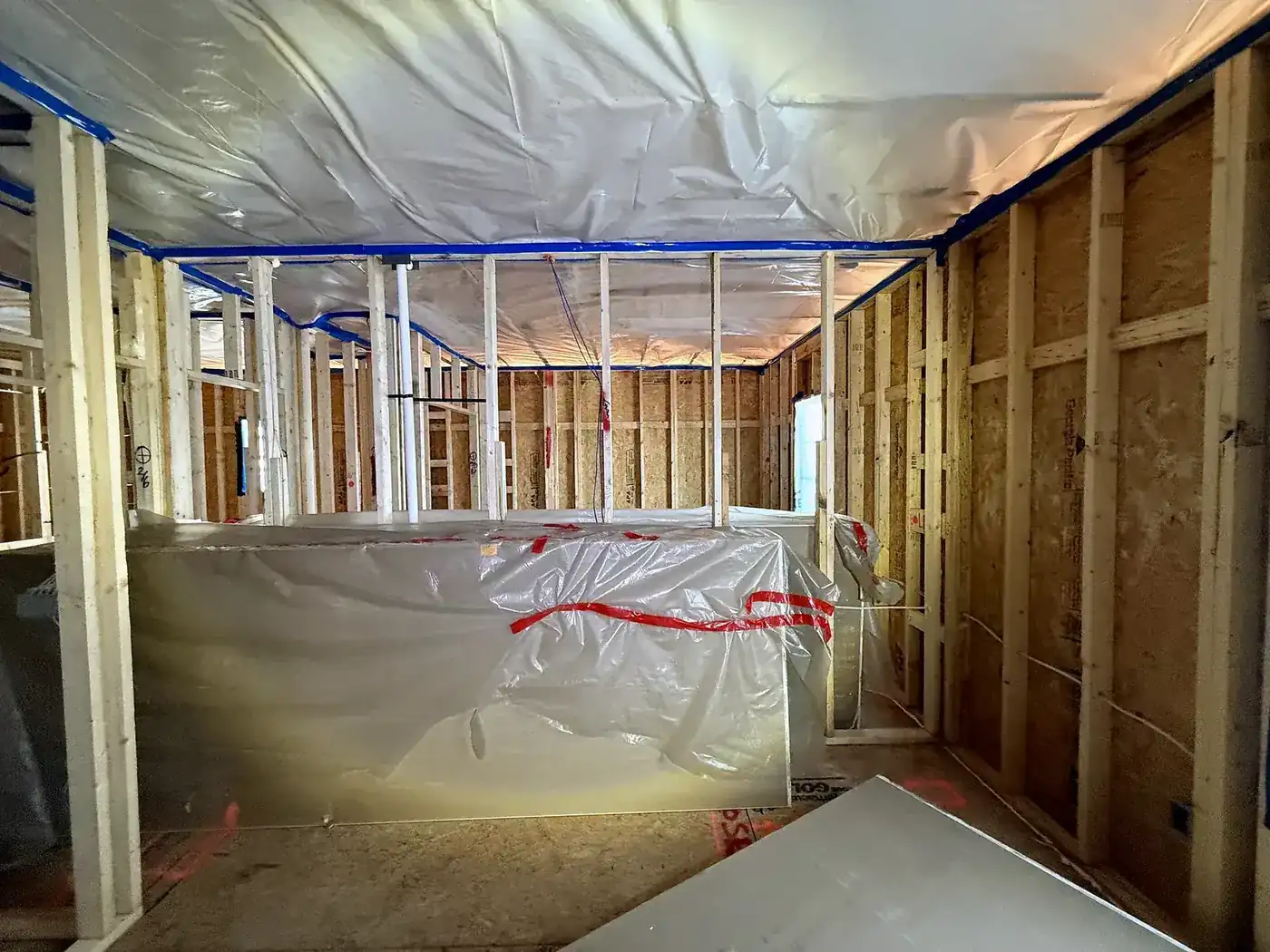
Pre-drywall mold inspection happens while framing, plates and sheathing are still exposed, before insulation and finishes limit access. A microbiologist walks the structure, maps moisture across questionable members, samples suspect surface growth for laboratory analysis where it matters, and delivers a photo-keyed report of the accessible conditions on the day of the visit, with any areas that could not be examined stated plainly.
What is a pre-drywall mold inspection?
A pre-drywall mold inspection documents the condition of a wall assembly, the framing, sheathing, and cavity, before insulation and drywall close it in. On new construction or a rebuild after a water loss, it captures moisture readings in the lumber and any microbial growth on the structure while everything is still visible and accessible. The timing that matters is after plumbing and electrical rough-in and before insulation goes in, which is the last window in which the cavity can be seen without demolition. Framing can be exposed to rain before a house is dried in, and any moisture still in it can be sealed behind the finish. What you end up with is a baseline record, photographs and instrument data, that serves as the reference point if a problem surfaces later. Scheduling is coordinated with the builder so the visit lands inside that window.
When this matters
Three scenarios that put a pre-drywall scope on the calendar.
- Rain-day framingThe stick-up caught a week of Florida afternoon storms. Lumber sat wet long enough that surface fungi colonized before the structure was dried in. Insulation and drywall are scheduled, and nobody wants to seal it in unread.
- Paused jobThe build sat open between phases. Permitting delay, materials backorder, custom-home owner change order. Weeks or months of exposed framing in a humid climate is its own moisture event, separate from any rain.
- Builder-independent verificationA custom-home buyer wants a third-party microbiologist to walk the framing before the GC closes the walls. The GC's own QA process is fine; the buyer wants a parallel record they commissioned, with a license tied to a different name.
What I document
What gets recorded, and what gets sampled.
- Full framing surveyAccessible members: top plates, studs, sole plates, sheathing (interior and underside), sill plates, headers, roof trusses, and blocking, as access allows.
- Moisture readingsOn any member that reads visually questionable, water staining, discoloration, swelling, or a location of concern (penetrations, transitions, weather-side exposure).
- Laboratory analysis of suspect growthA targeted swab or tape-lift on suspect surface growth, sent to an AIHA-LAP accredited laboratory. The result is reported at the level the method supports, which is often a genus or group rather than a species.
- Photo-keyed reportEvery finding is a numbered photo with a moisture reading, a location reference (room, wall, elevation), and a clearance recommendation, readable by the GC, the buyer, and an insurance carrier.
How it works on a job site
Timing, turnaround, and what you hand off.
Scheduled between dry-in and insulation start. Half a day for a typical single-family; full day for a multi-family build, a custom estate, or a structure with significant exposure. Lab turnaround on any swab is 24 to 72 hours. The written report follows the laboratory results, and the report is yours to keep in the construction file, or share with the buyer and the builder.
Pre-drywall FAQ
What builders and owners ask before they schedule.
When in the construction sequence should this happen?
After framing is complete, the mechanicals are roughed in, and the structure is dried-in, but before insulation and drywall start. That is the window when framing members, the underside of the sheathing, and the top and bottom plates are most accessible, subject to what the build sequence leaves exposed. Once insulation goes in, the substrate is hidden until demolition.
What does it cost?
Pricing varies by square footage, story count, and the sampling the visible conditions require. Most single-family pre-drywall scopes fall into a defined range that Daniel quotes after a brief sizing call. Quote-only on this service; the online inspection booking is reserved for residential and tenant scopes where the building is already closed.
Who typically pays, the builder or the buyer?
Either. When the builder commissions the inspection, the report reads as construction-quality documentation kept on file. When the buyer commissions it, the report reads as third-party verification independent of the GC. The scope of work is the same; the audience changes.
What happens if you find mold on the framing?
Suspect surface growth on lumber is swabbed or tape-lifted and sent to an AIHA-LAP-accredited laboratory. The result is reported at the level the method supports, often a genus or group rather than a species. The report locates the affected members in photos, records the moisture readings beside them, and states what further evaluation the findings may call for. Decisions about the work itself belong with the builder and the appropriate contractor.
Do you remediate?
No. Section 468.8419 places project-specific restrictions on assessors and remediators working on the same structure within specified 12-month periods, subject to statutory exceptions. PureSpec is built around that line. When findings require remediation, Daniel writes the IICRC S520-aligned protocol that an independent remediation contractor works to, then returns for post-remediation verification before drywall closes. Inspector, protocol writer, clearance verifier. Never the crew.
Service areas
Where we perform pre-drywall mold inspections.
Statewide Florida coverage. Much of the active pre-drywall work here is in master-planned communities, including the Horizon West communities around Winter Garden. Counties listed below are the proximity cluster; statewide pre-drywall callouts for production builders and custom-home work are quoted with travel built into the scope.
Central Florida coverage