Services · Statewide Florida · Certified Pathways™ Technician
Pathways™ Testing in Florida.
Florida buildings sit in a climate that punishes mistakes. Sub-tropical dew points, repeated hurricane water-loss cycles, and the slab-on-grade construction common from Jacksonville to Miami all conspire to push moisture into wall cavities that look fine on the outside. Pathways™ testing is the methodology built for the buildings where conventional sampling has run out of answers, and for the people still feeling sick in a home that “passed.”
What is Pathways™ testing in Florida?
Pathways™ biotoxin testing is a protein-pathway dust assay measuring fungal proteins, mycotoxin metabolites, and bacterial endotoxin from a single dust sample. In Florida, PureSpec collects to manufacturer protocol as a Certified Pathways™ Technician. It is used in CIRS, MCAS, and integrative-medicine environmental workups when conventional spore-trap air sampling returns unremarkable but symptoms persist inside the building.
What it measures
Peptide-bond protein at the points where buildings actually leak.
Pathways™ is a microfiber-swab sampling protocol developed to answer a question that air cassettes and settled-dust qPCR were never designed to answer: where, structurally, is microbial residue moving from a hidden source into the occupied space? The method abandons the “sample the middle of the room” convention and instead targets the building's transition geometry. Electrical outlets. Switch plates. Baseboard-to-floor joints. Window perimeters. Door thresholds. Plumbing and HVAC penetrations. The places where a wall assembly stops being continuous and air, moisture, and biological residue have a path to migrate.
Each absorbent swab is run across a defined transition surface, sealed, and shipped to an accredited Pathways™ laboratory. The lab tests for the peptide bond, a structural feature of all proteins, including those left behind by mold growth, fragments, and microbial residue. The result is not a species call. It is a measurement of biological protein density at that specific structural location. Combined across thirty to fifty sample points per five hundred square feet, the results draw a contamination-pathway map of the building.
Why it matters here
Why Pathways™ fits Florida's building stock and climate.
Florida is not a forgiving testing environment. Dew points stay above 70°F for roughly six months of the year. Most homes were built slab-on-grade with stucco or concrete-block exteriors, both of which trap moisture against framing if a flashing detail fails. Air handlers spend the summer pulling 50°F coil temperatures into 78°F living air, which means condensate has to go somewhere, and on a long enough timeline some of it ends up in the wall behind the unit, the closet floor below it, or the return plenum chase. Then a hurricane like Ian (2022), Idalia (2023), Helene (2024), or Milton (2024) lands a wind-driven rain event on a roof-to-wall transition that was already marginal, and the homeowner ends up with a leak history that no spore trap can fully characterise.
That is the building Pathways™ was built for. When a Florida home has been remediated once, twice, sometimes three times, and the occupants are still reporting symptoms, the contamination is no longer in the obvious places. It is in the assembly cavities the previous round of testing did not sample. A Pathways™ survey treats those cavities as the primary target, not the afterthought, and produces a written map of where the residue is actually concentrated. From there the next remediation cycle can be surgical instead of speculative.
Methodology
How a Florida Pathways™ survey runs.
- The testable area is gridded into five-hundred-square-foot zones for systematic coverage. A typical Florida single-family home is two to four zones.
- Each zone is sampled at thirty to fifty discrete transition points: receptacles, switch boxes, baseboard-to-floor cracks, window perimeters, door thresholds, plumbing penetrations, HVAC register margins, and any visible drywall seams or wall-ceiling intersections in moisture-implicated areas.
- Sampling is paired with infrared thermography and pin-and-pinless moisture metering to correlate Pathways™ hits against the building's current moisture map.
- Microfiber swabs are individually sealed, chain-of-custody logged, and shipped to an accredited Pathways™ lab.
- Results return as a per-zone protein concentration map with hot spots flagged for follow-up. Daniel writes the interpretation in plain English with a recommended remediation or supplementary sampling plan.
Method selection
Pathways™ vs ERMI vs HERTSMI-2 vs spore-trap.
Four different tests, four different jobs. Choosing the wrong one is how Florida homeowners end up with three rounds of remediation and no resolution.
- Spore-trap (air cassette), A snapshot of what is airborne in one room at one moment. Useful for documenting acute mold growth or comparing indoor air to outdoor reference. Limited for hidden, intermittent, or assembly-cavity contamination.
- ERMI, A 36-species qPCR panel run on settled house dust. Returns a relative-moldiness score for the entire sampled area. Good population-level screening for water-damage indicator species. Cannot localise where the contamination is physically located.
- HERTSMI-2, A focused five-species subset of ERMI used in CIRS literature as a habitability screen. Faster, cheaper, more interpretable than full ERMI for the specific question “is this building safe for a CIRS patient.”
- Pathways™, Targets location, not species. Use when ERMI or HERTSMI-2 has already flagged a problem and the next question is “where is it,” or when symptoms persist after remediation and the suspected source is hidden in the wall assembly.
The standard CIRS workup pairing in Florida is HERTSMI-2 for the habitability call plus Pathways™ for the location call. The two together produce a defensible picture for both the healthcare provider and the remediation contractor.
When to choose Pathways™
The scenarios where this test changes the outcome.
- CIRS or MCAS workup where the patient is still symptomatic in a building and prior conventional testing has not localised the source. Pathways™ is the diagnostic that maps the assembly route.
- Post-water-loss verification after Ian, Idalia, Helene, Milton, or any insurance-documented event. Visible damage has been repaired and the carrier has closed the file, but the occupant is still symptomatic. Pathways™ tells you whether residual contamination is still moving into the living space.
- Pre-purchase due diligence on a Florida property with a known prior moisture event or remediation history. Particularly relevant in older South Florida coastal homes and Central Florida 1960s-90s slab tracts.
- Multi-family and commercial buildings where shared walls, shared HVAC, and stacked plumbing make tenant-vs-tenant or unit-vs-unit contamination routes a real and litigable question.
- Repeated remediation that has not resolved the underlying problem. If the third remediation crew is being scheduled, the diagnostic is wrong, not the contractor. Pathways™ reframes the question.
Deliverable
What you get.
A written Pathways™ assessment report including the labelled sample map, per-zone laboratory results, the identified contamination pathways with photos of every sampled location, and a plain-English interpretation. Where appropriate the report ties the Pathways™ findings back into a recommended species-level or quantitative sampling plan, so your healthcare provider, remediation contractor, or insurance carrier has a defensible next step rather than a generic “elevated levels” verdict. Reports are written to be read by people, not boilerplate-generated.
FAQ
Frequently asked questions.
- Is Pathways™ testing recognised in Florida? Florida licenses the mold assessor performing the work, not the individual testing methodology. PureSpec's Daniel Melendez holds Florida Mold Assessor license MRSA #4575 and is a Certified Pathways™ Technician.
- How is Pathways™ different from ERMI or HERTSMI-2? ERMI and HERTSMI-2 return species-level data for an entire room. Pathways™ returns location-level data across thirty to fifty assembly transition points. The two are routinely paired.
- Do I need Pathways™ testing after a Florida hurricane? Not by default. It becomes the right call when visible damage has been repaired, symptoms persist, or remediation has been repeated without resolution.
- What does a Florida Pathways™ assessment cost? Scoped per project because sample count depends on testable area. A typical residential job lands in the low four figures including lab and report. Daniel scopes on the phone before work begins.
- How long until I have results? Field sampling is half-day to full-day. Lab turnaround is 7 to 14 business days. Final written interpretation follows within a few days of lab return.
Note. PureSpec performs environmental assessment only. Pathways™ testing documents environmental conditions. Interpretation of how environmental data relates to any medical condition is the role of a licensed healthcare provider.
The inspector
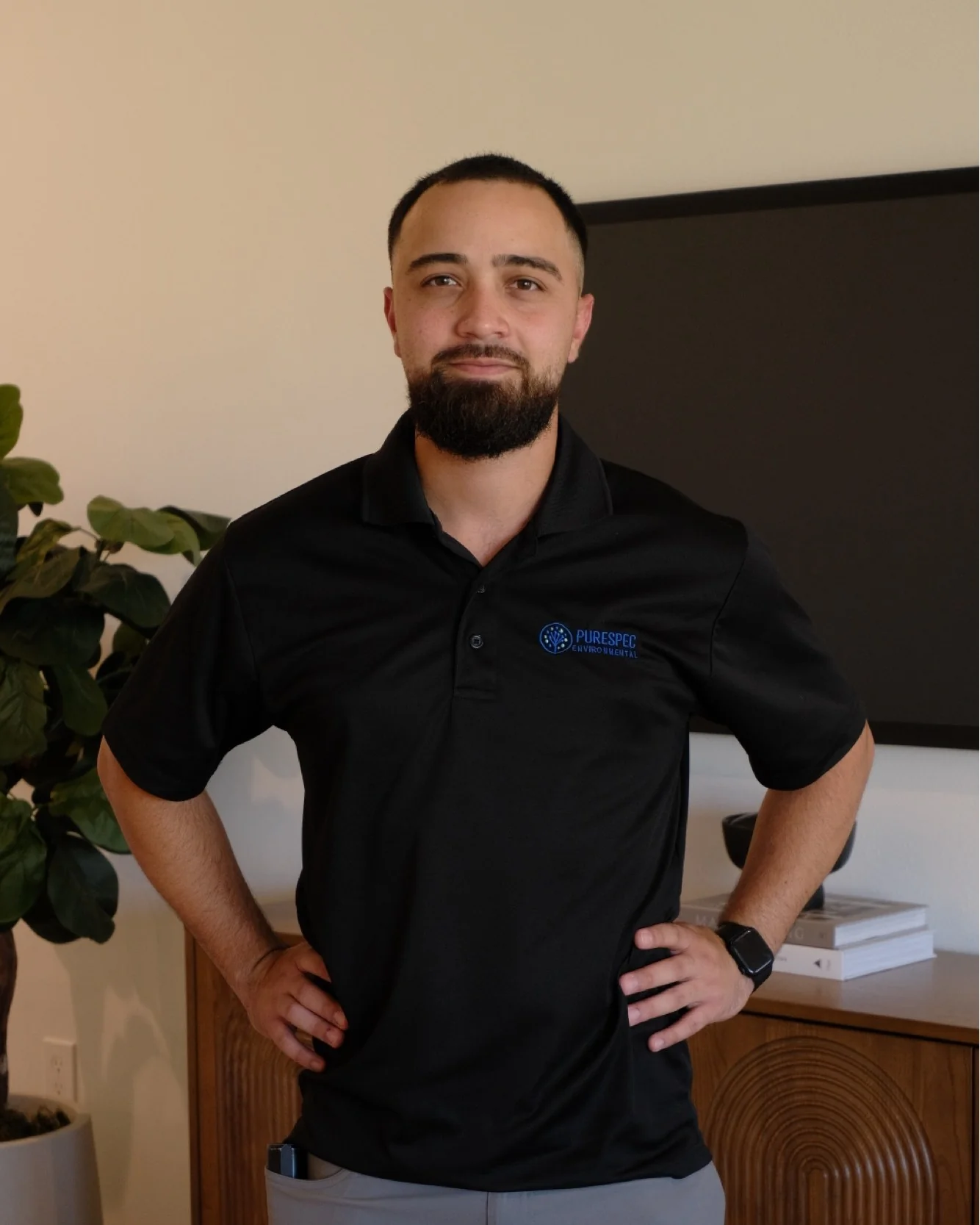
Daniel Melendez
Founder · Lead Inspector
- License
- MRSA #4575
- Certifications
- ACAC CMI · NAERMC CMH · NAERMC Green IAQ · Pathways™
- Education
- B.S. Microbiology
- Background
- Former lab analyst
Why a microbiologist
A microbiologist with a lab background, not a contractor with a weekend course.
Most Florida mold inspectors learned the trade in a weekend course. Daniel holds a Bachelor of Science in Microbiology and worked as an environmental laboratory analyst, the person other inspectors ship their samples to, before founding PureSpec.
He reads spore counts, growth patterns, and species behavior the way the labs that run the analysis do. Every inspection is founder-performed, lab-supported, and assessment-only: Daniel personally walks the property, collects the samples, interprets the lab data, and writes the report.
No subcontractors, no remediation upsell, no kickbacks. Florida law (FS 468.8419) prohibits the same firm from inspecting and remediating, and PureSpec is built around that line.
How an inspection actually works
Nine steps. Same scientific process, every property.
The depth of each step adapts to your situation. HVAC and borescope inspection happen when conditions warrant. Sampling is decided based on what your specific environment is asking, not a fixed checklist.
- 01
Consultation
We talk through what you’re seeing, the building, and the question you need answered. Free, no pressure, no upsell.
- 02
Visual inspection
Daniel personally walks every accessible space. No subcontractors.
- 03
Moisture mapping
Pin and pinless moisture meters identify elevated wall, floor, and substrate moisture invisible to the eye.
- 04
Thermal imaging
Infrared imaging surfaces temperature differentials that often correlate with hidden moisture or insulation gaps.
- 05
HVAC evaluation
Coil, plenum, return, and ductwork assessment. The #1 hidden vector for indoor mold in Florida buildings.
- 06
Targeted sampling
Air, surface, swab, ERMI, HERTSMI-2, mycotoxin, Pathways™, VOC, or formaldehyde, only the tests your situation warrants.
- 07
Lab analysis
Samples sent to AIHA-LAP-accredited third-party laboratories. Results returned within 24 to 72 hours of receipt.
- 08
Written report
Plain-English report with photos, lab data, moisture readings, observations, and clear next steps. Built to hold up with insurers, lenders, healthcare providers, and counsel.
- 09
Remediation protocol when warranted
If the report identifies remediation-grade mold, Daniel writes the IICRC S520-aligned remediation protocol, scope, containment, methods, and clearance criteria, that the remediation contractor works to. Florida law prohibits the same firm from inspecting and remediating, so the protocol stays independent of the work crew.
FAQ
Questions, answered.
Is Pathways™ testing recognised in Florida?
Pathways™ is a proprietary microfiber-swab peptide-bond protein methodology developed by Hygienic Pathways. Florida does not separately license individual testing methods, it licenses the mold assessor performing the work. PureSpec's Daniel Melendez holds Florida Mold Assessor license MRSA #4575 and is a Certified Pathways™ Technician, one of a small number in the state.
How is Pathways™ different from ERMI or HERTSMI-2?
ERMI and HERTSMI-2 are settled-dust qPCR tests that return a species and quantification profile for an entire room. Pathways™ samples 30 to 50 discrete structural transition points (electrical outlets, baseboard cracks, window perimeters, plumbing penetrations) with microfiber swabs analysed for peptide-bond protein residue, then maps those points so you can see which pathways into the living space are actually carrying contamination. The two methods answer different questions and are routinely used together.
Do I need Pathways™ testing after a Florida hurricane?
Not always. Most post-hurricane homes are well-served by visual assessment, moisture mapping, and conventional sampling. Pathways™ becomes the right call when visible damage has been repaired, the homeowner is still symptomatic in the building, or repeated remediation has not resolved the underlying complaint. It excels at finding the residual transport route that conventional sampling keeps missing.
What does a Florida Pathways™ assessment cost?
Pricing is scoped per project because the sample count depends on the testable area. A typical residential Pathways™ assessment in Florida runs in the low four figures including lab analysis and the written report. Daniel scopes the project on the phone before any work begins so there are no surprises on the invoice.
How long does it take to get Pathways™ results in Florida?
Field sampling typically takes a half-day to a full day depending on the testable area. Microfiber swabs are then sealed and shipped to the accredited Pathways™ lab. Lab turnaround runs 7 to 14 business days. PureSpec writes and delivers the final interpretation within a few days of receiving the lab data.
Service areas
Florida counties served for Pathways™ Testing.
Five counties have dedicated Pathways™ subpages with locally-specific scenarios and methodology notes. The remaining ten counties are served from the same statewide bench.
- Orange County, FL, Pathways™
- Miami-Dade County, FL, Pathways™
- Hillsborough County, FL, Pathways™
- Broward County, FL, Pathways™
- Duval County, FL, Pathways™
- Lake County, FL
- Osceola County, FL
- Seminole County, FL
- Polk County, FL
- Pinellas County, FL
- Palm Beach County, FL
- Volusia County, FL
- Brevard County, FL
- Marion County, FL
- Alachua County, FL
Central Florida coverage