
Services · PRV · Statewide Florida
Post-Remediation Verification in Florida.
Independent third-party clearance inspection and laboratory verification after a Florida remediation contractor has finished. Visual inspection of the contained area, accredited-lab air sampling against an outdoor reference, and a defensible pass / re-clean report your insurer, lender, healthcare provider, and next occupant can rely on.
What is post-remediation verification in Florida?
Post-remediation verification (PRV) is the independent third-party clearance inspection performed after a mold remediation contractor finishes, to verify the area is clean before reoccupancy or before containment comes down. Florida law (FS 468.8419) requires it be done by a firm independent of the remediation crew. In Florida, PureSpec performs visual assessment plus surface and air clearance sampling, with a written clearance report.
What it is
The clearance step Florida requires before re-occupancy.
Florida statute FS 468.8419 prohibits the same company from performing both mold assessment and mold remediation on a single project. The intent is to prevent the company that just performed the cleanup from also signing off on its own work. Post-Remediation Verification, or PRV, is the independent clearance step that closes that loop. A different assessor than the one who remediated visits the property while containment is still in place, inspects visually, samples for accredited-lab air analysis, and produces a pass / re-clean recommendation.
PRV is not a courtesy or a marketing line. It is a legal requirement in Florida for any project where assessment and remediation are being performed under license, and it is a transactional necessity for any insurance, real-estate, or healthcare-driven project where the clearance has to hold up later under scrutiny. PureSpec performs PRV only, not remediation, which is exactly why we can issue it.
What it consists of
Three parts, in this order.
- Visual inspection (while containment is still up). Dust deposits on surfaces inside the containment, residual staining on substrates, surface cleanliness of framing and structural elements, structural integrity of the rebuild prep. Photographed throughout. The visual portion is only meaningful while containment is intact and the area has not been reopened to the rest of the building.
- Air clearance sampling. Active spore-trap air sampling inside the contained area plus an outdoor reference sample collected at the same visit, under the same conditions. The outdoor sample is the baseline; the indoor sample must be at or below outdoor concentrations and species distributions to clear. Samples are sealed under chain-of-custody and shipped to an accredited third-party laboratory.
- Written interpretation. The lab results are interpreted against the outdoor reference and against the pre-remediation findings (when those are available). The report concludes with an unambiguous pass / re-clean recommendation, citing the specific reason for any failure. Most insurers, lenders, and providers accept PureSpec PRV reports without further questions because the format is consistent with ACAC / IICRC standards.
When to schedule
Timing is non-negotiable.
The PRV must happen after the remediation contractor has finished cleaning and HEPA-vacuuming the contained area but before:
- Containment barriers are removed
- The negative-air machine is shut down
- Any reconstruction begins (drywall replacement, flooring, paint, baseboard install)
- The previously contaminated area is reopened to the rest of the building
If containment is broken before clearance, the air sample no longer represents the post-remediation condition of the work area, it represents the post-remediation condition plus whatever happened during the breach. That distinction matters when an insurance carrier or a lawyer reads the report later. Most remediation contractors know to schedule PRV before takedown; if yours has not, call us before they break containment.
If it fails
A failed PRV is not the end of the project.
A failed PRV is a finding, not a verdict. The report names exactly which deficiency drove the failure: residual visible mold, elevated indoor spore counts versus the outdoor baseline, unaddressed moisture source, incomplete containment integrity, or a species mismatch suggesting the source was not fully removed. The remediation contractor performs the targeted re-clean. PureSpec returns for a second clearance pass.
A failed PRV discovered before re-occupancy is dramatically better than a failed remediation discovered after the family moves back in, or after the building changes hands. That is the entire point of the independent clearance step.
Why Florida specifically
The state runs more PRV than almost anywhere else.
Several Florida-specific patterns mean PRV is unusually frequent here:
- Repeated named-storm water events. Hurricane Ian (2022), Idalia (2023), Helene (2024), and Milton (2024) drove statewide rebuild cycles. Many Florida homes have run through two or three remediation projects in three years. PRV on each one is the only way to keep clearance records coherent.
- Year-round humidity load. A contained area in a Florida building can reabsorb moisture from the surrounding structure within hours if dehumidification fails. Clearance must happen before that re-equilibration, not after.
- Slab-on-grade construction. Sub-floor moisture migration is a common cause of remediation failure in FL. A PRV with proper moisture-meter and thermal-imaging support catches it before drywall closes in.
- High insurance-claim density. Florida runs more mold-driven property-insurance claims than any other state. PRV documentation is what makes the claim defensible.
- CIRS / MCAS re-occupancy decisions. Sensitized patients re-entering a remediated structure need a tighter clearance threshold than a generic clearance, that is why HERTSMI-2 and Pathways™ testing sometimes get added to a Florida PRV when the next occupant is medically sensitive.
What you get
Deliverable.
A written PRV report including: photographs of every sampled location and visual finding; the outdoor reference sample result; the indoor (contained-area) sample result; species-level identification where the lab provides it; comparison against pre-remediation findings if those exist; chain-of-custody documentation; and an unambiguous pass / re-clean recommendation in plain English. Reports are typically delivered within 24 hours of accredited-lab return.
Note. PureSpec performs assessment and verification only. We do not perform remediation. This page describes the PRV deliverable and Florida regulatory context; it is not legal advice. For questions about specific carrier requirements or transactional standards, contact us directly.
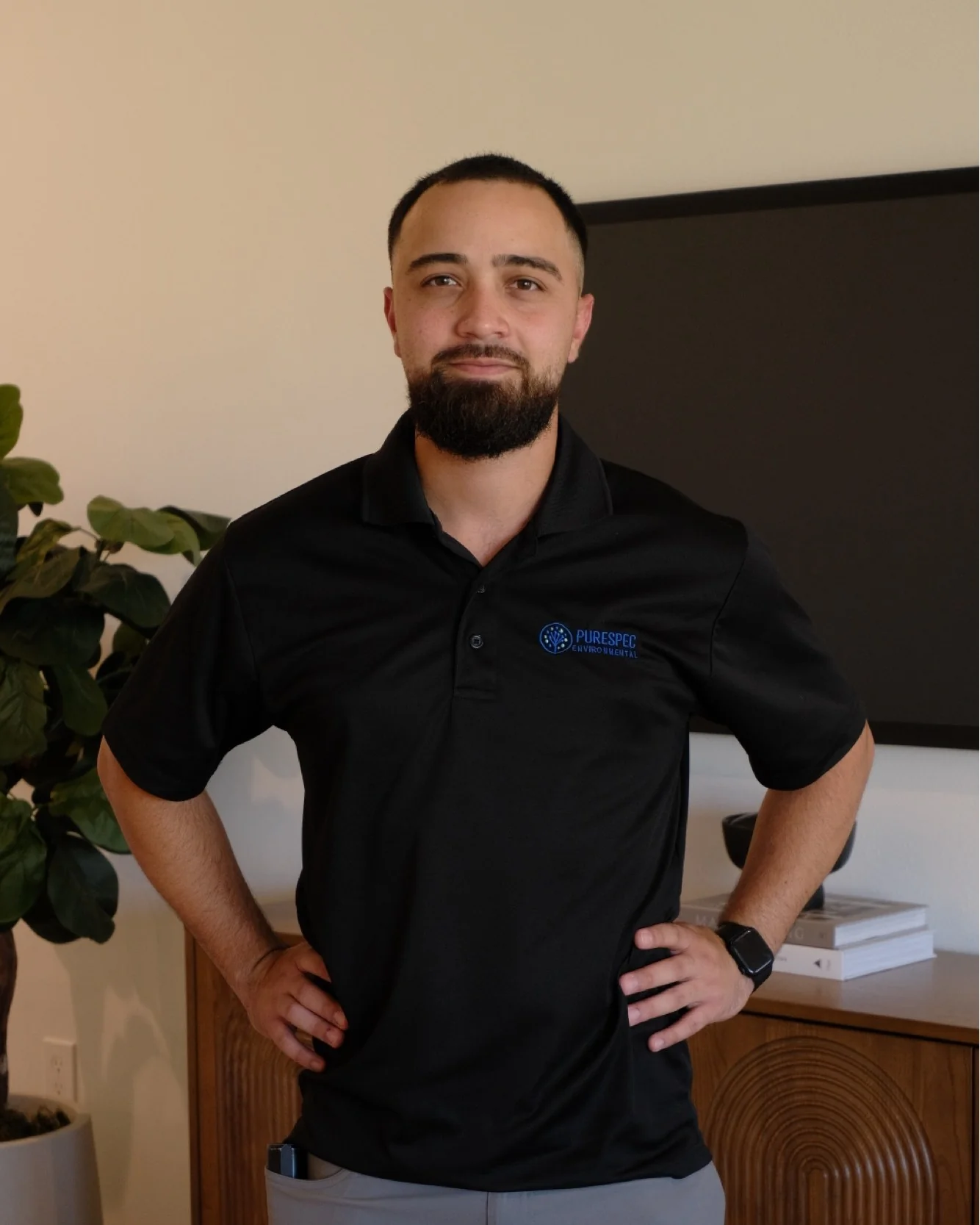
The inspector
Daniel Melendez
Founder · Lead Inspector
- License
- MRSA #4575
- Certifications
- ACAC CMI · NAERMC CMH · NAERMC Green IAQ · Pathways™
- Education
- B.S. Microbiology
- Background
- Former lab analyst
Why a microbiologist
A microbiologist with a lab background, not a contractor with a weekend course.
Most Florida mold inspectors learned the trade in a weekend course. Daniel holds a Bachelor of Science in Microbiology and worked as an environmental laboratory analyst, the person other inspectors ship their samples to, before founding PureSpec.
He reads spore counts, growth patterns, and species behavior the way the labs that run the analysis do. Every inspection is founder-performed, lab-supported, and assessment-only: Daniel personally walks the property, collects the samples, interprets the lab data, and writes the report.
No subcontractors, no remediation upsell, no kickbacks. Florida law (FS 468.8419) prohibits the same firm from inspecting and remediating, and PureSpec is built around that line.
How an inspection actually works
Nine steps. Same scientific process, every property.
The depth of each step adapts to your situation. HVAC and borescope inspection happen when conditions warrant. Sampling is decided based on what your specific environment is asking, not a fixed checklist.
- 01
Consultation
We talk through what you’re seeing, the building, and the question you need answered. Free, no pressure, no upsell.
- 02
Visual inspection
Daniel personally walks every accessible space. No subcontractors.
- 03
Moisture mapping
Pin and pinless moisture meters identify elevated wall, floor, and substrate moisture invisible to the eye.
- 04
Thermal imaging
Infrared imaging surfaces temperature differentials that often correlate with hidden moisture or insulation gaps.
- 05
HVAC evaluation
Coil, plenum, return, and ductwork assessment. The #1 hidden vector for indoor mold in Florida buildings.
- 06
Targeted sampling
Air, surface, swab, ERMI, HERTSMI-2, mycotoxin, Pathways™, VOC, or formaldehyde, only the tests your situation warrants.
- 07
Lab analysis
Samples sent to AIHA-LAP-accredited third-party laboratories. Results returned within 24 to 72 hours of receipt.
- 08
Written report
Plain-English report with photos, lab data, moisture readings, observations, and clear next steps. Built to hold up with insurers, lenders, healthcare providers, and counsel.
- 09
Remediation protocol when warranted
If the report identifies remediation-grade mold, Daniel writes the IICRC S520-aligned remediation protocol, scope, containment, methods, and clearance criteria, that the remediation contractor works to. Florida law prohibits the same firm from inspecting and remediating, so the protocol stays independent of the work crew.
FAQ
Questions, answered.
Why does Florida require an independent post-remediation verification?
Florida statute (FS 468.8419) prohibits the same company from performing both mold assessment and mold remediation on the same project. The intent is to prevent the company that just did the remediation from also signing off on its own work. An independent PRV by a third-party assessor preserves the integrity of the clearance and protects everyone downstream: the homeowner, the insurer, the lender, and the next occupant.
What does a PRV actually consist of?
Three things, in sequence. First, a visual inspection of the previously contaminated area while containment is still in place: dust deposits, residual staining, surface cleanliness, and structural integrity of the rebuild. Second, accredited-lab air sampling inside the contained area plus an outdoor reference sample collected at the same time. Third, written interpretation of the lab results against the outdoor baseline and against the pre-remediation findings, producing an unambiguous pass / re-clean recommendation.
When during the remediation timeline should I schedule the PRV?
After the remediation contractor has finished cleaning and HEPA-vacuuming but before containment is removed and before any reconstruction (drywall, flooring) is reinstalled. The visual portion is meaningful only while containment is still up; the air clearance portion is only valid while the contained area has not been reopened to the rest of the building.
What happens if the PRV fails?
The report names which specific deficiency drove the failure (residual visible mold, elevated indoor spore counts versus outdoor, unaddressed moisture source, incomplete containment, etc.) and what re-clean would resolve it. The contractor performs the re-clean. PureSpec returns for a second clearance attempt. A failed PRV is not unusual and is much better discovered now than after the homeowner re-occupies.
Will the insurance carrier accept your PRV report?
PRV reports are formatted with chain-of-custody, accredited-lab paperwork, photographs of every sampling location, and a clear pass / re-clean conclusion. Most major insurance carriers in Florida accept ACAC-CMI / state-licensed assessor reports of this format. For specific carrier requirements, call us before scheduling and we will format the deliverable accordingly.
Can you do a PRV after a remediation that another inspector wrote the protocol for?
Yes. The independence rule applies between the inspector and the remediator, not between two different inspectors. If a different mold assessor wrote the original remediation protocol, PureSpec can still perform the post-remediation clearance, provided we did not perform the remediation itself (we never do).
County PRV pages
Dedicated county post-remediation verification pages.
Eight counties have dedicated PRV subpages with locally-specific clearance scenarios, carrier expectations, and travel notes. The remaining counties are served from the same statewide protocol.
Service areas
Where we perform PRV.
All 15 currently-served Florida counties direct; statewide travel by appointment, including the SW Florida coast (Lee, Collier, Sarasota), Tampa Bay, the Atlantic coast, the First Coast (St. Johns, Duval), and the Panhandle (Bay, Escambia, Okaloosa).
Central Florida coverage