
Testing without Full Inspection
Targeted mold testing when you specifically need lab data.
Mold testing is appropriate when you don't need a full inspection, you need specific lab data. Common scenarios: prior inspection findings need laboratory data, a healthcare provider has requested specific environmental data, or a defined question needs a documented measurement.
3 Laboratory Samples Included Add-on samples available
Standard coverage includes Orange, Seminole, Lake, Osceola and Polk counties. For properties outside these counties, contact PureSpec for a written quote before booking. Any travel charge is disclosed in your written quote.
What is mold testing?
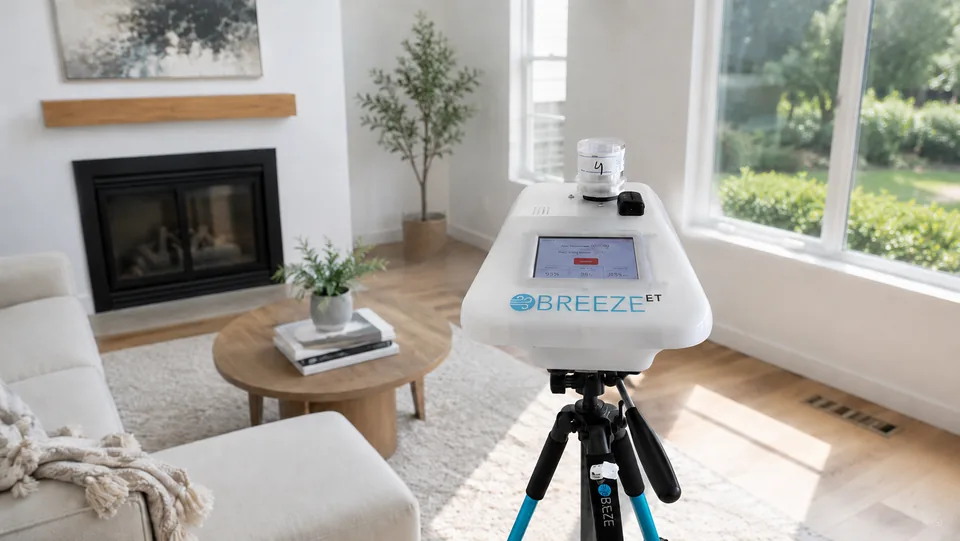
Mold testing is laboratory analysis of air, surface, or dust samples collected from a building, to characterize the fungal material collected and, for air samples, the concentrations in the air sampled. Routine direct microscopy usually reports genera or groups; species-level identification needs a method that supports it. Standard methods include calibrated spore-trap air sampling always paired with an outdoor reference, surface tape-lift or swab sampling on visible growth, and dust DNA panels such as ERMI and HERTSMI-2 for water-damaged-building markers. Each method answers a different question. Air describes conditions at the moment of sampling, a surface sample characterizes the material collected from a specific patch, and settled dust describes what has accumulated over time. That is why the right test depends on the question being asked, and why a sample taken without an inspection behind it often produces a number with no explanation attached. Results come from an AIHA-LAP-accredited third-party laboratory and are interpreted in a written report.
What it covers
What's included?
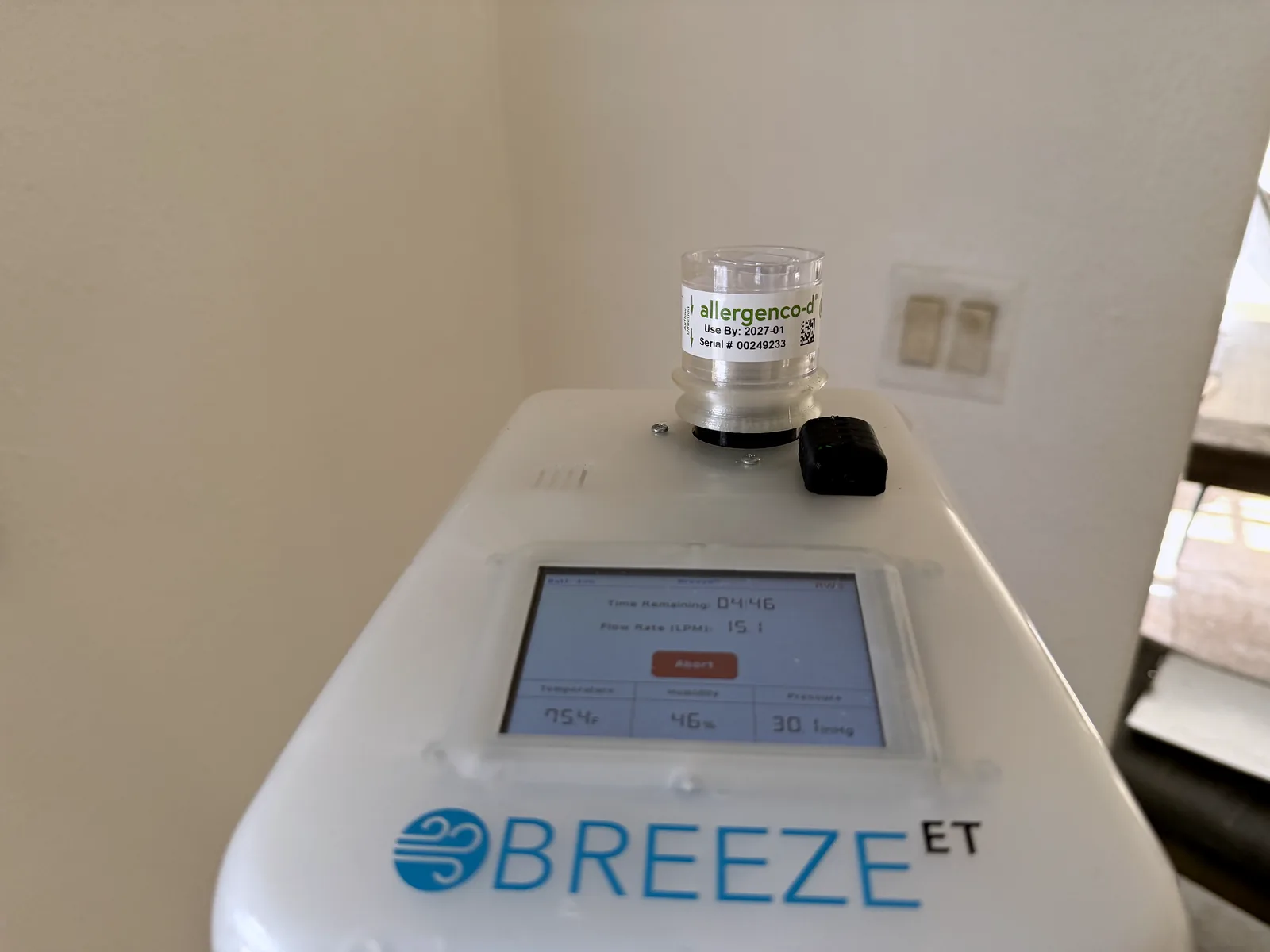
- Air samplingCalibrated spore-trap collection (Air-O-Cell or equivalent), indoor with an outdoor reference, to quantify what is airborne.
- Surface samplingSwab or tape-lift of visible growth, reported at the taxonomic resolution the selected analytical method supports.
- Wall-cavity samplingA minimally invasive check for hidden growth inside a wall where history or moisture readings point to it.
- Accredited laboratory analysisSamples ship under chain of custody to an AIHA-LAP accredited third-party laboratory and are interpreted, not just reported.
- Shareable documentationResults written so they can be shared with the healthcare provider or other party that requested the data. The report describes environmental conditions; it does not predict how another party will use it.
Optional lab testing
Testing you can add.
Three laboratory samples, air, surface, or wall-cavity, are included. When you need dust-based or chemical data instead of a spore count, any of these specialty panels can be added, and the cost is quoted up front:
- ERMI & HERTSMI-2 dust panelsDNA-based mold analysis scored against water-damaged-building markers, frequently requested for CIRS and MCAS medical documentation.
- Mycotoxin testingDetects the toxins some molds produce, a different question than how many spores are present.
- Pathways™ testingMicrofiber-swab sampling analyzed for peptide-bond protein, collected to manufacturer protocol.
- VOC & formaldehyde testingChemical off-gassing measurements for indoor-air-quality concerns beyond mold.
- Endotoxin testingBacterial-marker analysis for water-damaged or agricultural environments.
- Legionella water testingSampling of building water systems, cooling towers, potable water, spas, and fountains, for the bacteria that causes Legionnaires’ disease.
Add-on panels: ERMI, HERTSMI-2, mycotoxin, Pathways™, VOC, formaldehyde, endotoxin, and Legionella water testing. Every sample ships under chain of custody to an accredited third-party laboratory.
Air sampling
When is air sampling useful, and when is it not?
Air sampling draws a measured volume of air through a spore trap, and the laboratory counts and characterizes what it caught. An outdoor sample taken the same day is a useful reference for reading the indoor result, because outdoor air routinely carries spores, but it is one piece of context rather than a pass mark.
It is useful when:
- A specific indoor concern needs laboratory data alongside the building findings
- Visible growth has been remediated and verification sampling is part of the agreed criteria
- A landlord, property manager or physician has requested environmental data
- You need to compare one room against another to narrow down where a problem sits
It is a poor choice when it is the only thing you do. An air sample describes one moment in one room. Mold does not release spores continuously, so growth inside a wall cavity, under flooring or behind an air handler can be actively present while the air reads unremarkable. Running the HVAC, recent cleaning, closed windows, or simply sampling on a quiet day all move the number. That is why a normal air test does not rule out hidden mold, and why I read the building, its moisture and its HVAC before deciding whether an air sample is even the right instrument.
If the question is is there mold in this building and where, the building answers it and sampling confirms it. If the question is how much is airborne right now, air sampling is exactly the right tool. Matching the test to the question is most of the value.
When you need it
When is this service the right fit?
- Healthcare provider has requested specific data
- Insurance carrier needs quantified measurement
- Post-cleaning verification (informal)
- Spot-check after a partial remediation
- Comparison testing across multiple rooms or units
How this service works
How does mold testing actually work?
Three methods, each answering a different question. The method is chosen from the question you came with.
01Decide what is being asked
Air describes conditions at the moment of sampling. A surface sample identifies what is on a specific spot. Dust describes accumulated history. They are not interchangeable.
02Air sampling
Calibrated spore-trap sampling, with an outdoor reference taken the same day where it helps interpret the indoor result.
03Surface sampling
Tape-lift or swab taken directly on visible growth, to identify what is actually there.
04Dust panels
ERMI and HERTSMI-2 DNA panels for water-damaged-building markers, where accumulated history is the question.
05Accredited laboratory, then report
Samples travel under chain of custody to an AIHA-LAP-accredited third-party laboratory, and the report states what the method identified, usually genera or groups, with concentrations.
Microscopy, culture, and molecular methods.
The laboratory method is chosen from the question being asked. Each one sees a different slice of what is present, and each one is blind to something.
| Method | Viability | Typical identification basis | Useful for | Key limit |
|---|---|---|---|---|
| Nonviable direct microscopy | Does not distinguish live from dead | Visible morphology and spore type | Rapid air or surface particle characterization | Some groups cannot be reliably separated to genus or species by morphology alone. |
| Culture | Detects organisms that grow under the selected culture conditions | Colony growth plus a laboratory identification method | Questions that specifically require viable or culturable organisms | Growth is selective. Organisms that do not grow under the chosen conditions are not represented. |
| Molecular, DNA-based assay | Detects targeted genetic material | Method-specific DNA targets | Defined molecular panels such as settled-dust fungal assays | Detection does not by itself prove viability, current aerosolization, or source location. |
Service areas
Where we perform Mold Testing.
Orlando and Central Florida as the primary market, with statewide Florida projects available based on scope, scheduling, and travel requirements. Click the county nearest you for local context.
Honest answers
Mold testing, answered.
Which mold test should I ask for?
It depends on the question. Air sampling describes conditions at the moment of sampling, a surface sample characterizes the material collected from a specific patch, and settled-dust DNA panels describe what has accumulated over time.
Do you always take an outdoor reference sample?
For air sampling, yes. An outdoor reference taken the same day gives useful context for reading the indoor count, because outdoor conditions vary. It is interpreted alongside the building findings, not used as a pass mark.
What lab analyzes the samples?
An AIHA-LAP accredited third-party laboratory, with chain of custody on every sample. PureSpec does not run its own lab, and the results are interpreted in a written report rather than handed over as raw numbers.
Is mold air testing the same as a mold inspection?
No, and the difference matters. Mold air testing measures what is airborne at the moment the sample is taken, compared against an outdoor reference. It is one instrument reading, not an assessment. A proper mold inspection reads the building first: moisture, the HVAC system, the envelope, and where water has actually travelled, then samples where the findings call for it. An air test on its own can come back unremarkable while growth sits inside a wall cavity, which is why I do not sell air testing as a substitute for looking at the building.
Central Florida coverage