
Indoor Air Quality
Allergen testing: what you are actually breathing at home.
A mold test reports mold. Allergen testing widens the laboratory analysis to pollen and other biological and nonbiological particles in the air, from plant and animal material to fungal fragments and fibers. Read by a microbiologist in Orlando and Central Florida, and added to any inspection or booked on its own.
Standard coverage includes Orange, Seminole, Lake, Osceola and Polk counties. For properties outside these counties, contact PureSpec for a written quote before booking. Any travel charge is disclosed in your written quote.

What is allergen testing?
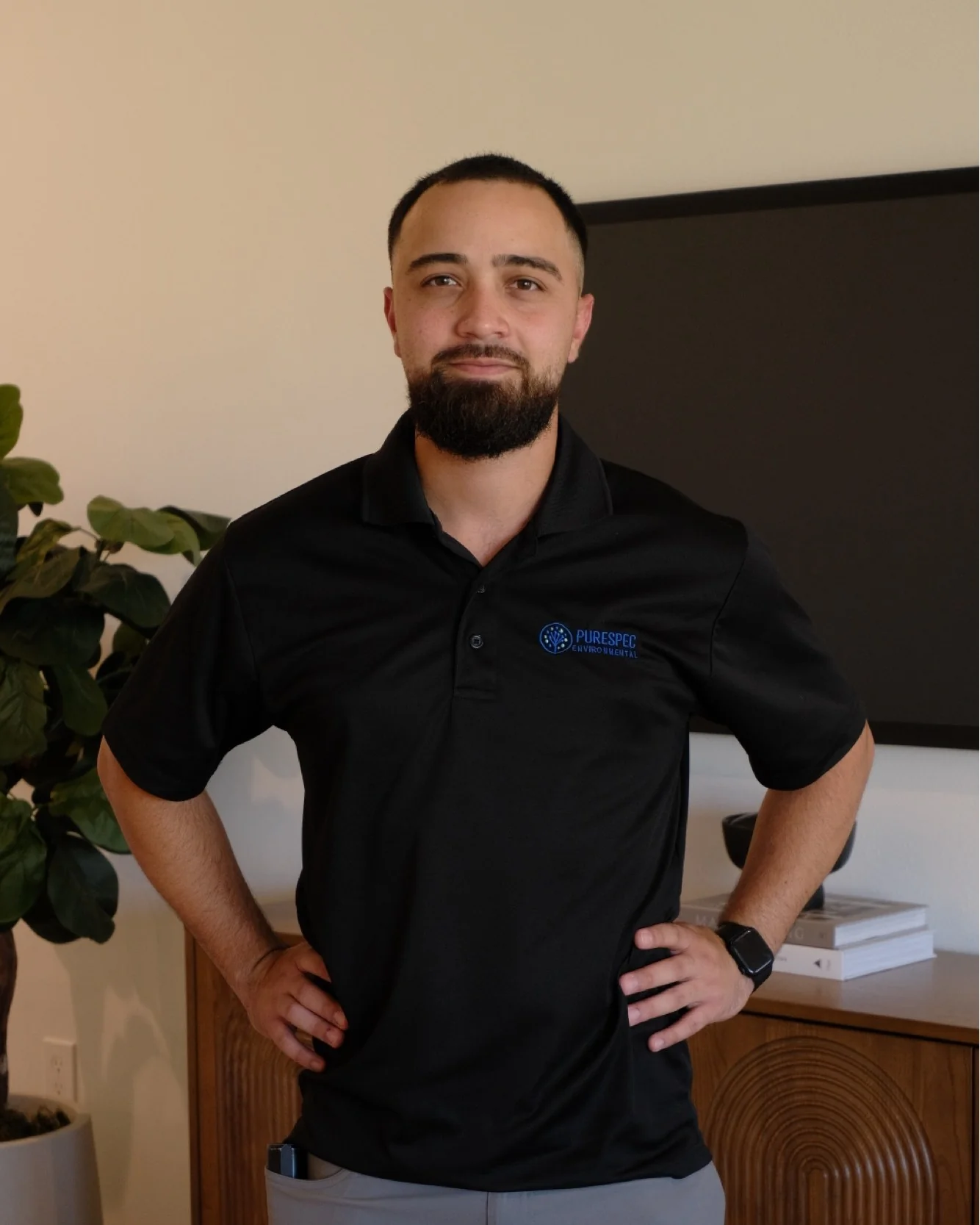
PureSpec offers laboratory analysis to identify pollen and other biological and nonbiological particles in collected indoor air samples. Examples of reported pollen categories include eucalyptus, grass, mulberry, oak, pine, ragweed and sycamore. These examples are not an exhaustive list; identification depends on the sample and the analytical method. Other reporting categories include algae, diatoms, fern and moss spores; wood and trichomes; epithelial skin cells, hair, insect parts and mites; fungal hyphal fragments; and cellulose, glass and synthetic fibers. The laboratory reports what it finds in each sample, so not every category appears in every result, and not every listed material is an allergen. Results characterize sampled particles, not the cause of an individual’s symptoms, which is a question for a healthcare provider. This is laboratory identification, separate from the on-site particle counts taken during an inspection. Daniel collects each sample with a calibrated air pump under chain of custody for analysis by an accredited laboratory.
What it detects
Everything else riding in your air.
A mold test tells you about mold. But mold is one of many kinds of particles in indoor air. Allergen testing widens the lens to the other particle categories the laboratory reports, sample by sample. Not every category appears in every sample.
- Pollen. Pollen types identified by the laboratory. Examples of reported categories include eucalyptus, grass, mulberry, oak, pine, ragweed and sycamore; the list is not exhaustive, and identification depends on the sample and the method.
- Other plant material. Algae, diatoms, fern and moss spores, and other material such as wood and trichomes.
- Skin cells, hair, insect parts and mites. Epithelial (skin) cells, hair, insect parts and mites carried in household dust and captured in the air sample.
- Fungal hyphal fragments. Mold structures beyond spores, complementing a standard spore-trap count.
- Fibers. Cellulose fibers, glass fiber and synthetic fibers.
When you need it
When is allergen testing the right fit?
- You want to know which particles besides mold are present in a room or a home
- A bedroom or other room of concern needs laboratory particle data
- Homes with pets or heavy household dust, where hair and skin cells collect
- After HVAC or insulation work, to check for glass or synthetic fibers in the air
- A mold air test came back low and the question is what else is in the air
How it works
One visit, the full picture.
Consultation → Daniel collects an air sample in each area of concern → an accredited lab identifies and counts the particle categories on its panel → you get a plain-English report, room by room, of what was found in the samples. Add it to any inspection, or book it on its own.
Honest answers
Allergen testing, answered.
Do I still need allergen testing if my mold test came back clean?
It depends on the question. A mold test only counts mold. Allergen testing identifies and counts other particles a mold test does not report, such as pollen, mites and insect parts, skin cells and hair, or glass and synthetic fibers. The results characterize the sampled particles; whether any of them relates to someone’s symptoms is a question for a healthcare provider.
Is this the same as a doctor’s allergy test?
No. A doctor’s allergy test, a blood or skin-prick test, measures how your body reacts. Allergen testing measures your environment: it identifies particles in collected samples of your home’s air, such as pollen, skin cells, hair, insect parts and mites. The two are complementary. We test the building, not the patient, and we do not diagnose or treat.
Which particles does the laboratory report?
Pollen, with examples such as eucalyptus, grass, mulberry, oak, pine, ragweed and sycamore (not an exhaustive list); other plant material such as algae, diatoms, fern and moss spores, wood and trichomes; epithelial skin cells, hair, insect parts and mites; fungal hyphal fragments; and cellulose, glass and synthetic fibers. The laboratory reports what is found in each sample: not every category appears in every result, and not every listed material is an allergen.
What does allergen testing cost?
It depends on how many areas you want sampled and whether it is added to an inspection or booked on its own. Quotes are custom and always free. Call (321) 324-7756 for a straight, no-obligation number.
How this service works
How does allergen testing actually work?
The question is not whether something is in the air. It is which particles, and how many of each.
01Scope the complaint
What the occupants react to, where in the building, and when. That decides where the sample is taken.
02Collect the air sample
A calibrated air sample is drawn onto a cassette in the space where the reaction happens.
03Laboratory microscopy
An analyst identifies and counts what is on the slide: pollen, other plant material, skin cells, hair, insect parts and mites, fungal hyphal fragments, and cellulose, glass and synthetic fibers.
04Named results, with amounts
The report replaces “something in here bothers me” with a specific list of what is present and in what quantity.
Service areas
Serving Orlando and all 67 Florida counties.
Based in Winter Garden in the Orlando metro, PureSpec covers all of Central Florida at standard rates and the rest of the state by custom quote. See the full service area.